Result Compaction Guide
This guide explains how TruvaG3 keeps large tool and agent results from overwhelming your LLM prompts — and how to tune that behavior. If you've ever watched an agent fetch a megabyte of logs or a giant JSON payload and wondered "how does that ever fit back into the model?", this guide is for you. The good news: it all runs automatically inside any orchestrating agent that has an AIClient — you don't need to configure anything to get it.
Table of Contents
- What Is Result Compaction (and Why You Need It)
- The Big Picture: Three Layers, Two Prompt Paths
- Quick Reference
- Layer 1 — Result Trimming (the structural floor)
- Layer 2 — Result Distillation (LLM-first, the synthesis path)
- Layer 3 — Continuation Digests (the planning path)
- How a Result Flows Through
- Configuration
- Customizing and Extending
- Observability
- Cost and Latency
- Tuning Scenarios
- Troubleshooting
- Reference
1. What Is Result Compaction (and Why You Need It)
Failed-operation evidence
Continuation and built-in synthesis include bounded facts from failed actual dispatches: same-attempt inputs and structured error code, plus the existing terminal error separately. This is a derived view; raw execution records retain their original bytes. Partial/omitted views are labelled, legacy records have unavailable dispatch evidence, and pre-dispatch binding rejections are not tool failures. Successful attempts are excluded from this view.
FailedOperationViewConfig defaults to 4,096 encoded bytes per input value,
16,384 per failed step and 32,768 per prompt. Continuation additionally limits
each view to the existing failure share (min(per-step floor, total/(failed+1))).
That parent's legacy accounting counts pre-encoding bytes despite its CHARS
names; the new child ceilings count final rendered UTF-8 bytes including escapes.
Every failed step and the newest success retain their existing soft-retention
guarantee. Larger failure views can displace older successes: the
failure_evidence.continuation_retention span event reports successful step IDs
with and without projection. Synthesis bounds combined error/input views
separately from its existing success-result budget. Framing and legacy short
failure markers are outside these child JSON ceilings.
Use WithFailedOperationView or the config field to restrict/disable the view.
The typed FailedOperationInputPolicy can allow or omit inputs, not rewrite
them; errors omit all inputs of that attempt. The policy must be immutable and
concurrency-safe. It is an application disclosure policy, not framework
redaction. Applications explicitly call ProjectFailedOperationEvidence when
authorizing comparable facts in a delegated result. See API Reference for code.
When an agent runs a multi-step plan, each step produces a result, and those results have to be fed back into the LLM in two places:
- Synthesis — the final-answer prompt, which includes the step results the answer is built from.
- Continuation planning — between phases, the planner re-reads what's been done so far to decide the next steps.
The problem: real tool results aren't small. A kubectl get pods -o json over a busy namespace is ~1 MB. A Loki query can return hundreds of log streams. A web scrape is tens of KB. Put all of that into a prompt verbatim and you run into two limits:
- Hard limit — you exceed the model's context window and the call fails.
- Soft limit (the bigger one) — reasoning accuracy degrades well before the context fills. See EFFECTIVE_PROMPTS_GUIDE §2.2: accuracy on a controlled task drops from ~0.92 to ~0.68 as inputs grow into the low thousands of tokens. A prompt full of raw payload is a prompt that reasons worse.
Result compaction is the framework's answer: shrink each result to fit a budget while preserving the signal the model actually needs — and do it automatically, so agent authors don't have to think about it.
See It in Action
The clearest way to feel this is a data-heavy request. Point the devops-chat-agent (with the devops-tool and devops-observability-tool deployed) at a query like:
"I want you to do a deep analysis of the logs for the pods that have
toolin their name and are in the truvag3-examples namespace. Analyze the logs from the last 30 minutes, and tell me how things are looking. Are there any operational or performance issues?"
To answer this, the agent fans out across both tools — devops-tool lists/inspects the pods (kubectl … -o json, ~1 MB) and devops-observability-tool pulls each pod's Loki logs (hundreds of KB to several MB). Instead of stuffing all of that into the synthesis prompt, the orchestrator distills each oversized result down to a query-relevant summary on a fast model (chunking and map-reducing the biggest ones). You can watch it happen in the registry-viewer's execution diagram — the distill nodes are the compaction calls sitting between the tool steps and the final synthesis:
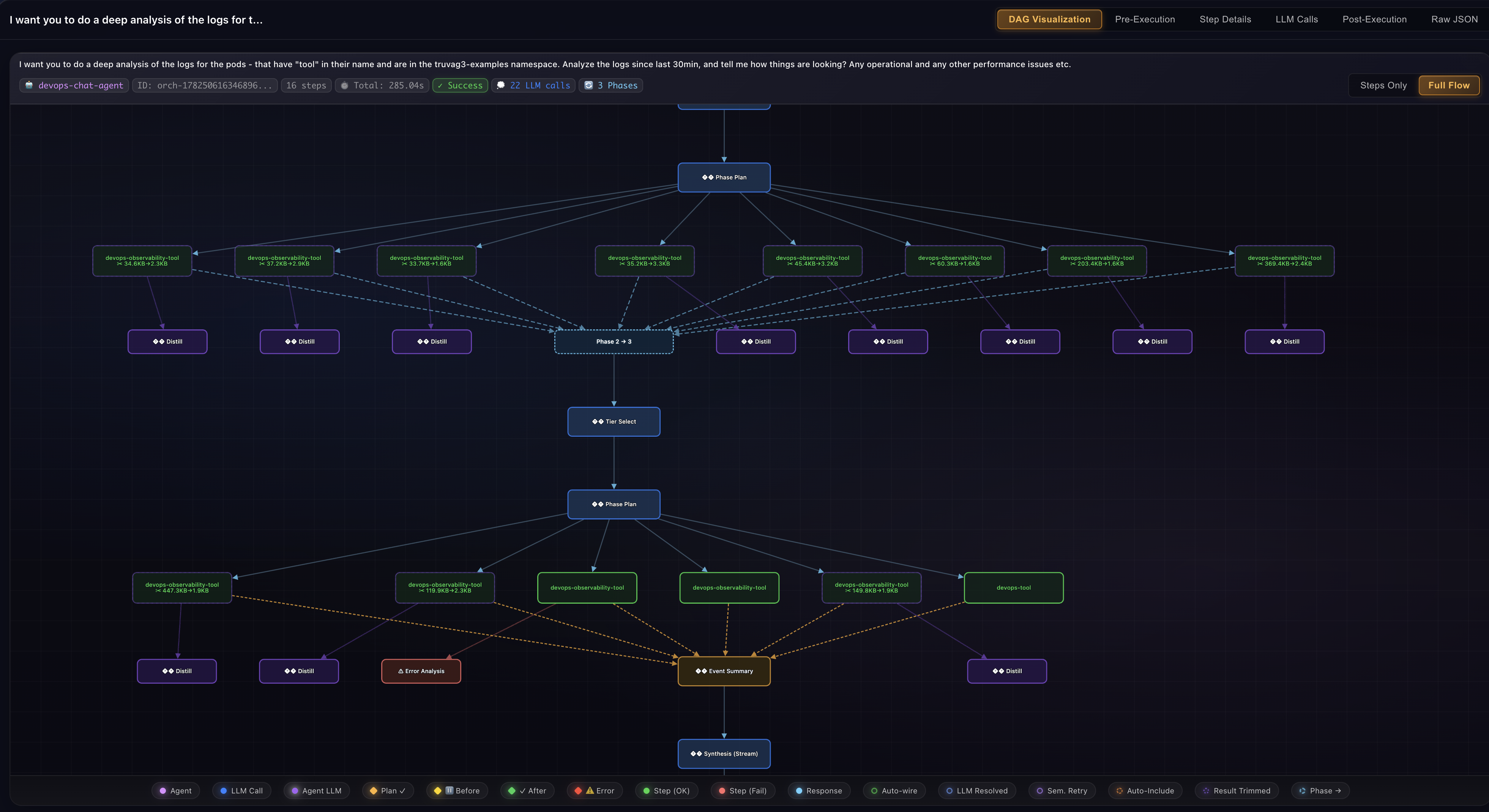
Open the same request in the registry-viewer's LLM-debug view to see the result_distillation interactions in detail (including map-reduce chunk i/N calls for the largest results). The rest of this guide explains what each of those steps does and how to tune it.
2. The Big Picture: Three Layers, Two Prompt Paths
There are three compaction mechanisms, and which one runs depends on where the result is headed.
| Layer | Runs on | LLM? | What it produces |
|---|---|---|---|
Result Trimming (StructuralTrimmer) | synthesis, resolution-source & tool-input paths; the synthesis fail-open floor | No | a size-bounded subset (JSON → valid-JSON body + a [trimmed …] note; non-JSON → keyword-scored sentence selection or a byte-cut fallback) |
Result Distillation (LLMDistiller) | the synthesis prompt | Yes (fast model) | a query-relevant summary |
| Continuation Digests | the continuation planning prompt | No (rarely yes) | structure-complete JSON skeletons |
The mental model:
                          ┌──────────────────────────────────────────────┐
  step result (maybe MB)  │                                              │
  ───────────────────────▶│   over a size budget?                        │
                          │      │                                       │
                          │      ├─ headed to SYNTHESIS  ── Distillation │
                          │      │     (LLM-first; structural floor if   │
                          │      │      no AIClient; map-reduce if huge) │
                          │      │                                       │
                          │      └─ headed to CONTINUATION ── Digest     │
                          │            (JSON skeleton; non-JSON → floor; │
                          │             rare fast-model escalation)      │
                          │                                              │
                          │   Trimming is the synthesis path's           │
                          │   deterministic floor (alone if no           │
                          │   AIClient). Continuation has its own.       │
                          └──────────────────────────────────────────────┘
Three design principles tie it together:
- Fail-open, always. Every layer degrades to a smaller, safe result rather than failing the request — no AIClient → structural floor; cache error → recompute; deadline hit → partial + disclosure.
- Default-on. You get sensible compaction out of the box; you opt out or tune, you don't opt in.
- Prompt-only — the full result is never lost. Compaction shrinks only what the LLM sees in a given prompt. The complete, untouched result stays in the orchestrator's step memory, so
{{step-N.fieldpath}}templates always resolve against the full value at execution time. A digest or summary is a view for reasoning, never a replacement for the data — which is what makes lossy compaction safe.
3. Quick Reference
Defaults that matter most (full tables in the Limits Cheatsheet):
| Setting | Default | Env Var |
|---|---|---|
| Result trimming enabled | true | TRUVAG3_RESULT_TRIM_ENABLED |
| Per-result trim budget | 64 KiB | TRUVAG3_RESULT_TRIM_MAX_BYTES |
| Distillation enabled | true | TRUVAG3_RESULT_DISTILL_ENABLED |
| Distill trigger size | 16 KB | TRUVAG3_RESULT_DISTILL_THRESHOLD |
| Distill target output | 4 KB | TRUVAG3_RESULT_DISTILL_TARGET |
| Distill model | fast alias | TRUVAG3_RESULT_DISTILL_MODEL |
| Map-reduce trigger (tokens) | 150000 tokens | TRUVAG3_RESULT_DISTILL_CONTEXT_TOKENS |
| Map-reduce trigger (bytes) | 0 (disabled) | TRUVAG3_RESULT_DISTILL_MAPREDUCE_THRESHOLD |
| Continuation aggregate budget | 192 KiB | TRUVAG3_CONTINUATION_RESULT_MAX_TOTAL_CHARS |
| Continuation non-JSON floor | 10000 bytes | TRUVAG3_CONTINUATION_RESULT_MAX_CHARS |
All byte budgets are integers in bytes (16 KB =
16384). All values are env-tunable without a code change.
4. Layer 1 — Result Trimming (the structural floor)
The StructuralTrimmer is the deterministic, LLM-free baseline. It does whole-unit structural selection to fit a byte budget: it inventories the result's fields and array items, then keeps whole units in breadth-first order — shallowest first, and largest-first within a depth — descending into a unit only when it's too big to keep whole, so a unit that fits is kept intact rather than decomposed. Units that don't fit are dropped (recorded as FieldsDropped). A top-level array is filled from its head; a nested array is first capped to its first 500 items and then run through the same whole-unit sort (shallowest-then-largest-first), so its kept items aren't strictly a head sample. Crucially, the primary cut is not a query-relevance ranking — that's distillation's job; relevance scoring here only feeds a secondary backfill pass and key ordering, never the main selection. On the JSON path the kept payload is valid JSON, but the trimmer appends a short plain-text annotation — [trimmed: N/M fields kept …], or [severely reduced … treat as UNKNOWN] when it keeps under 5% — so the returned string is a JSON body followed by that note, not a pure-JSON document. A non-JSON input (logs, plain text) uses keyword-scored sentence selection, restoring retained sentences to their original order. With no usable keywords or no whole sentence fitting the budget, it falls back to a head byte cut. A disclosure identifies lost content; the result has no JSON body. (The always-valid-JSON guarantee belongs to continuation digests; see §6.) It is structure-aware, not structure-complete: it can drop whole fields. Because it makes no LLM call, it's fast, free, and always safe — which is why it also serves as the fail-open floor for the synthesis distiller.
It runs in several spots, each with its own budget:
| Budget | Default | Env Var | Purpose |
|---|---|---|---|
| Per-result cap | 64 KiB | TRUVAG3_RESULT_TRIM_MAX_BYTES | per-result ceiling when several results share one synthesis prompt (multi-result allocation) |
| Total prompt | 192 KiB | TRUVAG3_RESULT_TRIM_MAX_TOTAL_BYTES | all results combined in one synthesis prompt — and the per-call budget when a single result is processed |
| Micro-resolution source | 64 KB | TRUVAG3_RESULT_TRIM_MAX_MICRO_BYTES | source data fed to parameter micro-resolution / semantic retry |
| Agent input per-param | 0 (no cap) | TRUVAG3_RESULT_TRIM_MAX_AGENT_INPUT_BYTES | tool→tool data flow |
| Schema-mapping threshold | 16 KB | TRUVAG3_RESULT_TRIM_SCHEMA_MAPPING_THRESHOLD | switch micro-resolution to schema-guided mapping above this |
Fidelity-first tool→tool flow. Note that agent-input trimming defaults to 0 — no cap. When one tool's output feeds another tool's input, the downstream tool gets the full upstream result, not a trimmed one. The reasoning: a tool consuming data programmatically usually needs all of it, unlike an LLM consuming it for reasoning. Set it > 0 (or supply a custom AgentInputProcessor) only if you specifically want to bound inter-tool payloads.
Prioritizing specific fields. ResultTrim.PreserveKeys lists object keys — matched case-insensitively — that the trimmer should favor keeping. Each listed key gets a large boost in the trimmer's relevance score, which (as above) drives the secondary backfill pass and key ordering, not the primary whole-unit cut: preserved fields are strongly favored when the trimmer fills the remaining budget, and are surfaced earlier in what it keeps. Set it via WithResultPreserveKeys([]string{"id", "error"}) or the config.ResultTrim.PreserveKeys field (there's no env var); it's honored by every StructuralTrimmer the factory builds — the synthesis floor and the distiller's Stage-1 pre-filter, the resolution-source trim, the continuation distiller's pre-filter (§6.4), and agent-input trimming when that's enabled. It's a preference, not a guarantee — a tight enough budget can still drop a preferred field — so it raises the odds a critical field (an id, an error) survives rather than pinning it. Because it changes what the trimmer keeps (and so what the LLM sees), the preserve set is folded into the distill cache salt (§5.3).
Disable trimming with TRUVAG3_RESULT_TRIM_ENABLED=false. This turns off the synthesis path — structural trimming and the synthesis LLM distiller (which is gated on trimming) — but not the continuation-planning distiller, which is wired independently. To turn off all LLM compaction, use TRUVAG3_RESULT_DISTILL_ENABLED=false (the master switch: it gates both the synthesis distiller and the continuation distiller); TRUVAG3_CONTINUATION_MAX_ESCALATIONS=0 disables only the continuation escalation.
5. Layer 2 — Result Distillation (LLM-first, the synthesis path)
Structural trimming preserves shape, but for the final answer you often want meaning: "of these 200 log lines, which ones matter for the user's question?" That's what distillation does — and it's the primary compaction path for the synthesis prompt.
5.1 How it works
Distillation is On by default (opt out with TRUVAG3_RESULT_DISTILL_ENABLED=false). When a step result exceeds TRUVAG3_RESULT_DISTILL_THRESHOLD (16 KB) and the orchestrator has an AIClient, it runs a two-stage pipeline:
- Stage 1 — structural pre-filter. The
StructuralTrimmerreduces the raw result toPreFilterBudget(128 KB) so the LLM isn't handed the entire payload. - Stage 2 — LLM distill. A fast model (Haiku 4.5 / GPT-5.6 Luna / Gemini Flash-Lite per provider, via the portable
fastalias) summarizes the pre-filtered content to ~TargetSize(4 KB), conditioned on the user's query and the step's task so it keeps what's relevant.
Identifier fidelity. The JSON round-trips on the compaction and synthesis path — the Stage-1 pre-filter, map-reduce chunking, and the final synthesis re-parse — decode numbers with full precision preserved (
UseNumber), so large integer identifiers (snowflake IDs, 64-bit keys, anything above 2⁵³) survive verbatim rather than being silently rounded to a float or rewritten in scientific notation. The distill prompt also instructs the model to copy identifiers, keys, timestamps, and numeric values byte-for-byte; on evidence-style data (records, log lines, rows) it selects and copies matching units rather than paraphrasing them. (This covers what the LLM sees; the tool→tool template-resolution path —{{step-N.field}}binding — still decodes with standard JSON and can round a large number to a float, so don't rely on it to carry a 64-bit ID between tools.)
Without an AIClient (or with TRUVAG3_RESULT_DISTILL_ENABLED=false), distillation is skipped: the factory installs a plain StructuralTrimmer that runs at the synthesis budgets (64 KiB per-result / 192 KiB total) — not the 128 KiB Stage-1 pre-filter, which exists only inside the distiller. You get the deterministic trimming path without an LLM call.
When several results share one synthesis prompt, the budget allocator is distillation-aware: a result that will be distilled is sized at its post-distill footprint (~TargetSize), not its raw bytes, so one huge result doesn't starve the others' budgets.
5.2 Very large results: map-reduce
A 128 KB pre-filter would throw away most of a 1 MB result before the LLM ever saw it — which is exactly where the important finding might be hiding. So when a result's estimated token count exceeds TRUVAG3_RESULT_DISTILL_CONTEXT_TOKENS (150000 tokens ≈ 525 KB), distillation switches to map-reduce:
- Split the full result into chunks of ≤128 KB, preferring structural boundaries — top-level JSON array elements, then the dominant array inside a JSON object, then newline-delimited records — and falling back to a raw byte split (which may cut a record) only as a last resort. When the result is an object wrapped around a dominant array (e.g.
{"data":{"result":[…]},"status":…,"stats":…}), the ordinary grouped chunks each replicate the wrapper and sibling fields, so that surrounding context reaches the model rather than being dropped with everything outside the array. An array element too big for one chunk is emitted as its own standalone chunk(s) — split recursively, never truncated — and the wrapper is still represented via the grouped chunks, or, when every element is oversized, via a separate wrapper chunk whose dominant array holds a sentinel marker (so an emptied array is never misread as "zero records"). If the wrapper is too large to replicate efficiently, the chunker falls back to newline splitting when the data has line boundaries, otherwise a raw byte split (surfaced aschunk_strategy: linesorbytes, §10). - Distill each chunk concurrently (up to
TRUVAG3_RESULT_DISTILL_MAP_CONCURRENCY, default 8), on the fast tier. - Reduce the chunk extracts into one final summary.
This is what lets a multi-MB batch of logs surface a finding buried at byte ~500 K — a positional truncation would miss it entirely.
Routing by bytes (opt-in). There are two independent triggers into map-reduce: the token estimate above (TRUVAG3_RESULT_DISTILL_CONTEXT_TOKENS), and an optional byte threshold, TRUVAG3_RESULT_DISTILL_MAPREDUCE_THRESHOLD. The byte threshold is 0 (disabled) by default — out of the box, routing is context-only. Set it to a byte size and any result larger than that map-reduces even when it comfortably fits the model context, so the whole result is represented to an LLM instead of only its pre-filtered head. That's the knob for the 128 KB–525 KB band (see the caveat below). It's independent of CONTEXT_TOKENS; a value below PreFilterBudget (128 KB) is ignored with a factory warning, because a result that small is a single chunk — routing it to map-reduce adds no fan-out benefit over the ordinary single-call distill (that lone chunk still runs an LLM extract call when it fits the context).
Here's a real map-reduce distillation in the registry-viewer's execution diagram — a single oversized result fans out into concurrent map-reduce chunk i/N calls that reduce into one summary:
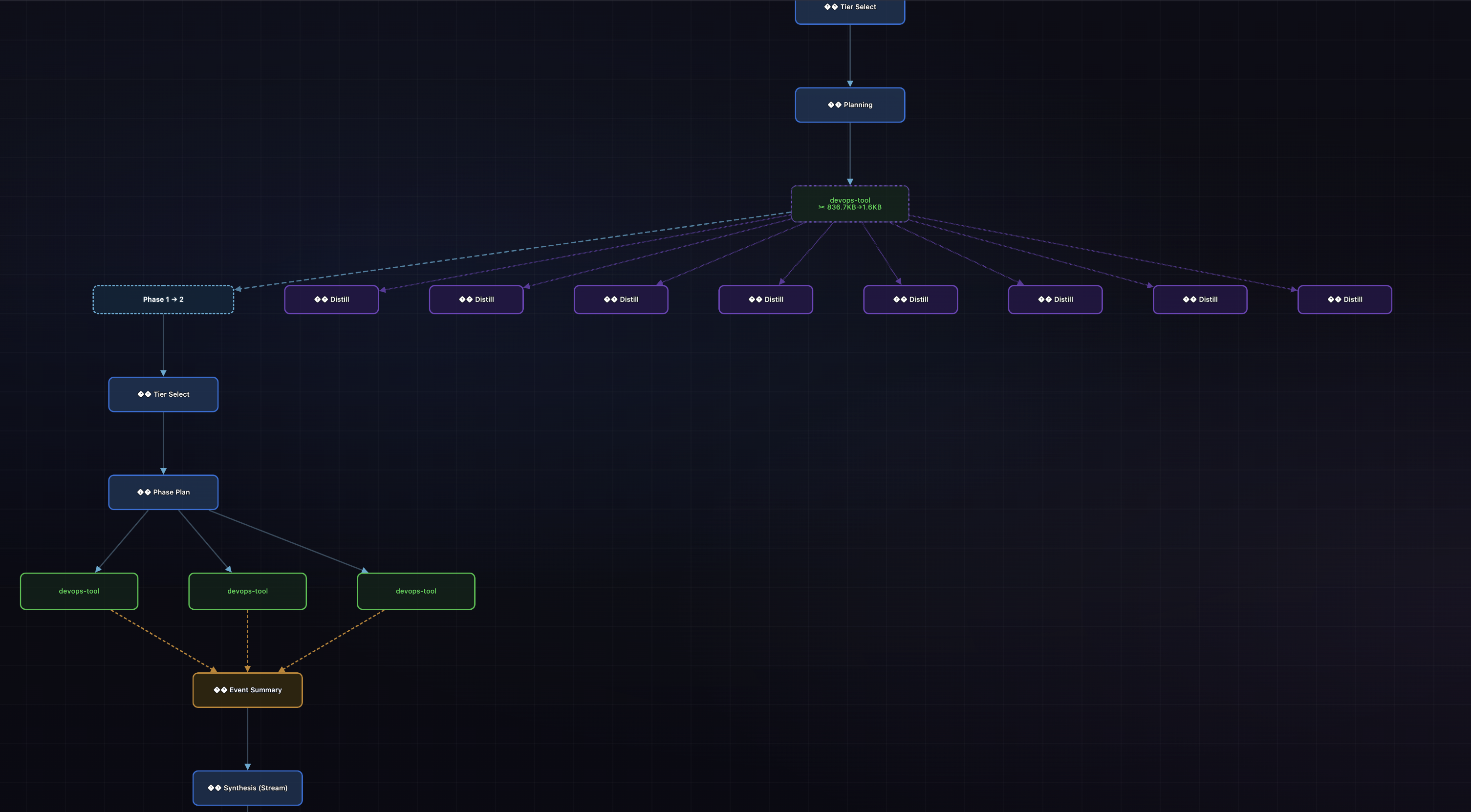
Single-call caveat. By default map-reduce engages only above the context threshold (~525 KB). A result in the 128 KB–525 KB band takes the single-call path, where Stage 1 pre-filters to
PreFilterBudget(128 KB) before the LLM — so the model sees the structural pre-filter, not the whole result. That drop is disclosed: the distilled output carries a[partial source: the model received ~N% of the source by bytes …]note and the trim metadata setscontent_lostandpartial_coverage, so a downstream reader is never told the sample is the whole. If you'd rather the entire result in that band reach the LLM, setTRUVAG3_RESULT_DISTILL_MAPREDUCE_THRESHOLDto a byte size (per "Routing by bytes" above) so it map-reduces regardless of the token estimate; alternatively lowerTRUVAG3_RESULT_DISTILL_CONTEXT_TOKENSor raiseTRUVAG3_RESULT_DISTILL_PREFILTER. (Results below 128 KB are pre-filtered without loss.)Upper boundary. Compaction targets results up to roughly the model's context window. GB-class outputs don't belong in a prompt at all — reduce them at the source (have the tool return less) or use an extract-then-reference workflow (artifact / code-exec backend). Don't try to compact a gigabyte in-prompt.
5.3 Caching and deadlines (both fail-open)
- Cache (opt-in). Caching is off unless you supply a
core.DigestCacheviadeps.DistillCache— it's nil by default, so out of the box every distillation recomputes. When a cache is supplied, identical(result + instruction + query + budget)inputs (plus a config salt: prompt version, model, target size, pre-filter budget, model context tokens, the map-reduce byte threshold, anyPreserveKeys, and any per-callAIOptionsOverride— so changing the routing knobs, the Stage-1 preserve set, or overriding the model / max tokens / temperature / system prompt all invalidate stale entries) reuse a prior distillation forTRUVAG3_RESULT_DISTILL_CACHE_TTL(5m), turning scheduled/repetitive runs into cache hits. For request-aware clients, the key also includes the stable, secret-free provider policy and route fingerprint, so rule, middleware, resolved-model, surface, or semantic-route changes cannot reuse an incompatible answer; an unstable fingerprint bypasses both cache lookup and storage, and after a miss the executed request report must match the preflight fingerprint before the result is written. On a hit, the processor restores the stored coverage metadata before returning the output (the cache holds a versioned envelope of the output plus its trim metadata), so an audited distillation reads the same whether freshly computed or cached; an invalid or unsupported envelope fails open by recomputing. Failed or partial outputs — a deadline cut or a map-reduce run where some chunk calls failed — are deliberately not cached, so a transient error can't be served for the whole TTL. A nil/erroring cache simply recomputes — never fails. (The continuation distiller has no cache wrapper — it fires rarely, so a cache would mostly miss.) - Deadline — each compaction is bounded by
TRUVAG3_RESULT_DISTILL_DEADLINE(45s). On timeout the single-call path falls back to the structural floor; the map-reduce path returns the chunks that finished plus an honest "partial" disclosure. (That same[partial: …]disclosure also covers chunks lost to a failed model call, not only the deadline — see §5.6.) Keep this under your HTTP gateway timeout.
5.4 Scope
The synthesis result distiller is scoped to the synthesis path. Parameter resolution (micro-resolution, semantic retry) uses the deterministic structural trimmer for its source data — those prompts drive their own resolution LLM call and must not be lossily summarized first. Continuation planning uses digests (next section); it has its own separate distiller, invoked only for the rare non-JSON escalation (§6.4) — never for the synthesis prompt.
5.5 Every distillation knob
| Knob | Default | Env Var | What it controls |
|---|---|---|---|
| Enabled | true | TRUVAG3_RESULT_DISTILL_ENABLED | master switch; =false falls back to the structural floor |
| Trigger threshold | 16 KB | TRUVAG3_RESULT_DISTILL_THRESHOLD | minimum result size to invoke the LLM (below it → structural trim to the allocated budget, not the LLM; raw only if it already fits) |
| Pre-filter budget | 128 KB | TRUVAG3_RESULT_DISTILL_PREFILTER | Stage-1 structural cap before the LLM (sized to fit the fast-tier context) |
| Target output | 4 KB | TRUVAG3_RESULT_DISTILL_TARGET | approximate size of the distilled summary |
| Model | fast | TRUVAG3_RESULT_DISTILL_MODEL | model/alias for distill calls (see the alias note below) |
| Cache TTL | 5m | TRUVAG3_RESULT_DISTILL_CACHE_TTL | how long an identical distillation is reused (only when a deps.DistillCache is supplied — no caching by default) |
| Compaction deadline | 45s | TRUVAG3_RESULT_DISTILL_DEADLINE | wall-clock bound per compaction (fail-open on timeout) |
| Map-reduce trigger (tokens) | 150000 tokens | TRUVAG3_RESULT_DISTILL_CONTEXT_TOKENS | estimated token count above which a result is chunked + map-reduced |
| Map-reduce trigger (bytes) | 0 (disabled) | TRUVAG3_RESULT_DISTILL_MAPREDUCE_THRESHOLD | byte size above which a result map-reduces regardless of the token estimate (whole result → LLM, not just the pre-filtered head); 0 keeps routing context-only; a value below PREFILTER (128 KB) is ignored with a warning |
| Map concurrency | 8 | TRUVAG3_RESULT_DISTILL_MAP_CONCURRENCY | parallel chunk distillations in the map-reduce path |
Use a portable model alias, not a concrete name. With a
ChainClient(multi-provider failover), setTRUVAG3_RESULT_DISTILL_MODELtofast/default/smart— a concrete model name is provider-specific and breaks failover (the chain classifies a 404 as a non-retryable client error and stops instead of trying the next provider). Thefastalias resolves to each provider's efficient tier (Haiku 4.5 / GPT-5.6 Luna / Gemini Flash-Lite). Per-call AI options (model, max tokens, temperature, system prompt) can be overridden programmatically withWithResultDistillAIOptions(...).
5.6 Disclosure notes: how a compacted result flags what it dropped
Compaction is honest about loss. Whenever any layer deterministically drops content, it appends a single-line note to the result and sets content_lost in the trim metadata (see ResultTrimMetadata). Each note starts on its own line with a [ prefix (so it's machine-parseable and can be stripped) and tells the downstream model to treat omitted content as UNKNOWN, not absent — the invariant that keeps lossy compaction safe: the model is never allowed to read a trimmed result as complete. You may see any of these in a step result or the synthesis prompt:
| Note (prefix) | Emitted by | What it means |
|---|---|---|
[trimmed: …] | Structural trim (Layer 1) | Whole fields, array items, or sentences were dropped to fit the budget — [trimmed: N/M … kept …] with exact unit counts. A plain byte truncation instead reads [trimmed: original → kept bytes …]. |
[severely reduced: kept N of ~M bytes (P%) …] | Structural trim (Layer 1) | The trim kept under 5% of the source (the degenerateKeptRatio floor) — too little to be representative. Metadata sets degenerate=true with kept_ratio. |
[partial source: the model received ~N% of the source by bytes …] | Distillation (Layer 2) | A single-call distill's Stage-1 pre-filter dropped content before the LLM (the 128 KB–525 KB band, §5.2), so the model saw only part of the source. Metadata sets partial_coverage=true. |
[partial: N of M segments analyzed …] | Map-reduce (Layer 2) | Only N of M chunks completed — the CompactionDeadline was hit, or a chunk's model call failed and was skipped. The unanalyzed segments are UNKNOWN. |
[findings truncated: …] | Map-reduce reduce (Layer 2) | The combined extracts (from the segments that completed) were truncated to fit the budget. This does not imply every segment was analyzed — a [partial: …] note can accompany it, so check chunks_completed/chunks_total. The combine_truncated_reason span attribute says which: reduce_failed (a transient reduce-call failure) or over_context (too large to reduce). |
[reduced without model analysis: …] | Synthesis floor | No result processor was configured (e.g. a fallback seam), so the prompt byte-truncated the result and no LLM analyzed the dropped tail. |
One note is advisory, not framework-guaranteed. The distill system prompt asks the model to end an over-budget distillation with
[truncated: N additional matching units omitted to fit budget …]. Unlike the six framework notes above — which are appended deterministically and are recognized by the framework's annotation stripper — this model-emitted[truncated: …]form is best-effort (it depends on the model obeying the instruction) and is deliberately not registered with the stripper: real tools emit their own[truncated: …]trailers, and peeling them would silently delete a tool's own truncation signal. When Stage-1 actually drops content, the authoritative, framework-guaranteed signal is the[partial source: …]note, not the model's[truncated: …].
6. Layer 3 — Continuation Digests (the planning path)
Between phases, the continuation planner re-reads completed steps to decide what's next. It doesn't need the values in those results — it needs their structure, so it can reference fields and avoid re-issuing work. So instead of distilling (an LLM call per step) or truncating (which mangles JSON), completed-step results are rendered as structure-complete JSON digests.
6.1 What a digest looks like
A digest is a skeleton of the result that's always valid JSON:
- All object keys are kept (up to
TRUVAG3_CONTINUATION_DIGEST_MAX_KEYS, default 50; wider "map-shaped" objects are sampled to N sorted keys + a sentinel). - Arrays are head-sampled to
TRUVAG3_CONTINUATION_DIGEST_ARRAY_SAMPLE(default 3) elements + a length sentinel ("…197 more of 200"). - Long strings are elided to a descriptor (
"…(16384 chars)") aboveTRUVAG3_CONTINUATION_DIGEST_SCALAR_MAX(default 200).
A 519 KB Loki result becomes a ~600-byte skeleton that still tells the planner: there's a data.streams array of 200 entries, each with line and labels fields. That's everything the planner needs.
6.2 Addressability — the key idea
Digests are lossy on values but complete on structure, and that's deliberate: the planner references fields with {{step-N.fieldpath}} templates, and the full value resolves from memory at execution time — not from the digest. So a plan can say {{step-9.response.data.streams}} and the executor binds the entire 200-entry array at run time, even though the planner only ever saw the skeleton.
6.3 The budget: greedy recency-fill
TRUVAG3_CONTINUATION_RESULT_MAX_TOTAL_CHARS (192 KiB) is a target that drives eviction — not a hard cap. The fill rule:
- Failed steps are always kept — they carry a lot of signal but take little space (they're short
[FAILED: …]markers). They count against the budget but are never evicted. - Successful steps fill newest-first until the budget is spent; older ones are evicted with a
[showing N of M completed steps]note (they remain referenceable by step-ID at execution). - The newest successful step is always kept, even if it alone exceeds the budget, so the section is never empty.
- Steps render in chronological order, so the newest sits at the end of the prompt, where models pay the most attention.
Because failed steps and the newest successful step are force-kept — and per-step orchestrator NOTEs plus the [showing N of M …] marker (always emitted, even when N = M) are appended after the budget decision — the rendered section can modestly exceed the target on large or failure-heavy fan-outs.
6.4 Non-JSON results and the escalation path
Not every result is JSON (logs, markdown, CSV). A non-JSON result can't be digested, so it gets a floor preview sized by TRUVAG3_CONTINUATION_RESULT_MAX_CHARS (10000 bytes; the setting retains its legacy name). A capped number of the newest non-JSON steps (TRUVAG3_CONTINUATION_MAX_ESCALATIONS, default 8; 0 disables) may escalate to the continuation distiller for a fast-model summary that replaces the floor preview. This rarely triggers on all-JSON workloads, and is always fail-open (an empty summary leaves the floor in place).
6.5 Every continuation-digest knob
| Knob | Default | Env Var | What it controls |
|---|---|---|---|
| Aggregate budget | 196608 bytes | TRUVAG3_CONTINUATION_RESULT_MAX_TOTAL_CHARS | Soft byte target before enclosing prompt encoding; failed steps and the newest successful step are retained, with markers allowed beyond the target |
| Non-JSON floor | 10000 bytes | TRUVAG3_CONTINUATION_RESULT_MAX_CHARS | floor-preview size for a non-JSON step (JSON steps are digested, not floored) |
| Max escalations | 8 (0 disables) | TRUVAG3_CONTINUATION_MAX_ESCALATIONS | newest non-JSON steps that may escalate to the distiller per phase |
| Array sample | 3 | TRUVAG3_CONTINUATION_DIGEST_ARRAY_SAMPLE | head-sample size for arrays in a digest |
| Scalar elision cap | 200 | TRUVAG3_CONTINUATION_DIGEST_SCALAR_MAX | max inline string length before it's elided to a …(N chars) descriptor |
| Object key cap | 50 | TRUVAG3_CONTINUATION_DIGEST_MAX_KEYS | max keys kept per object before sampling to sorted keys + a sentinel |
These are all top-level
OrchestratorConfigfields (env-tunable; noWith*option) — they're numeric tuning, so they live as env vars.
7. How a Result Flows Through
Putting it together, here's the decision a result goes through:
result produced by a step
│
├─ used as INPUT to another tool ───────────────▶ pass through raw (fidelity-first; cap only if MaxAgentInputBytes > 0)
│
├─ used as SOURCE for param resolution ─────────▶ StructuralTrimmer to MaxMicroResolutionBytes (deterministic, never the LLM distiller)
│
├─ headed to the SYNTHESIS prompt ──────────────▶ ≤ threshold? structural trim to the budget (raw only if it already fits)
│                                                  > threshold + AIClient? distill (fast model)
│                                                      └─ > model context? chunk → map-reduce
│                                                  no AIClient? StructuralTrimmer floor
│
└─ headed to the CONTINUATION prompt ───────────▶ valid JSON? structure-complete digest
                                                   non-JSON? floor preview (+ rare fast-model escalation)
                                                   whole section targeted by aggregate budget — soft, not a hard cap (newest-first, N-of-M eviction; failed + newest always kept)
8. Configuration
8.1 Environment variables (numeric tuning)
All budgets, thresholds, and models are env-tunable — deploy-time changes, no rebuild. The three families:
TRUVAG3_RESULT_TRIM_*— structural trimming (Layer 1)TRUVAG3_RESULT_DISTILL_*— distillation (Layer 2)TRUVAG3_CONTINUATION_*— continuation digests (Layer 3)
Full tables with every variable, default, and description: Environment Variables Guide and Limits Cheatsheet.
Precedence (highest wins): a programmatic With* option or explicit config field → the TRUVAG3_* variable → the built-in default. (These compaction knobs have no "standard" env-var aliases — only the TRUVAG3_* names are parsed into DefaultConfig. Standard vars like OPENAI_API_KEY / REDIS_URL configure other subsystems, not these budgets.)
Parsing semantics. Byte budgets are plain integers in bytes (16 KB = 16384); durations (CACHE_TTL, DEADLINE) are Go duration strings (5m, 45s). For numeric budgets, an empty or non-positive value is ignored and the default stands — a typo can't silently zero a budget. Three numerics instead treat 0 as a deliberate, accepted value (not "ignore, use default"): TRUVAG3_CONTINUATION_MAX_ESCALATIONS (0 disables continuation escalation), TRUVAG3_RESULT_TRIM_SCHEMA_MAPPING_THRESHOLD (0 disables schema-guided mapping), and TRUVAG3_RESULT_DISTILL_MAPREDUCE_THRESHOLD (0 = disabled, which is also its default — parsed with >= 0 so an explicit 0 pins it off against a future nonzero default). Booleans are stricter: TRUVAG3_RESULT_TRIM_ENABLED and TRUVAG3_RESULT_DISTILL_ENABLED count as enabled only for the literal true (case-insensitive) — any other non-empty value (1, yes, on) parses as false, so always set them to exactly true or false. (The compaction deadline and cache TTL can be set to 0 to disable only programmatically; an env value of 0 is ignored and the default stands.)
8.2 Programmatic options
config := orchestration.DefaultConfig()

// Trimming
config.ResultTrim.MaxResultBytes = 32768          // or WithResultTrimming(true, 32768)
config.ResultTrim.PreserveKeys = []string{"id"}   // or WithResultPreserveKeys([]string{"id"})

// Distillation (default-on; mutate individual fields, don't reassign the whole struct —
// a wholesale literal would zero CacheTTL / CompactionDeadline / ModelContextTokens)
config.ResultDistill.DistillThreshold = 65536     // or WithResultDistill(true, 65536)
config.ResultDistill.Model = "fast"               // or WithResultDistillModel("fast")
// Per-distill-call AI options (model / max tokens / temperature / system prompt):
//   WithResultDistillAIOptions(&orchestration.AIOptionsOverride{Model: orchestration.StringPtr("fast")})
// config.ResultDistill.Enabled = false           // opt out entirely

// Continuation digests are top-level OrchestratorConfig fields (env-tunable; no With* option)
config.ContinuationDigestScalarMax = 400          // surface longer salient values at plan time
8.3 Dependency-injection seams (behavioral plugs)
Numeric tuning belongs in env vars; behavioral replacement belongs in OrchestratorDependencies. Each seam is honored if set, otherwise the factory builds the default:
| Seam | Replaces | Used for |
|---|---|---|
deps.ResultProcessor | the synthesis processor | a custom (possibly LLM) compactor for the final-answer prompt |
deps.SourceResultProcessor | the resolution-source trimmer | a custom deterministic processor for micro-resolution source data |
deps.AgentInputProcessor | the tool→tool transform | redact / validate / enrich / trim parameters before dispatch |
deps.ContinuationDistiller | the continuation distiller | a custom summarizer for non-JSON continuation escalations |
deps.DistillCache | (none — nil disables) | a core.DigestCache (e.g. Redis-backed) so distillations are cached across pods |
9. Customizing and Extending
The compaction contract is the single-method ResultProcessor interface:
type ResultProcessor interface {
    ProcessForPrompt(ctx context.Context, result string, maxBytes int, stepContext ResultProcessorContext) string
}
Honesty contract for custom processors. If your processor drops, truncates, or samples content, report it by calling the exported
CaptureResultTrimMetadata(ctx, ResultTrimMetadata{... ContentLost: true})from insideProcessForPrompt. The framework prepares the per-step metadata slot before invoking you, so this surfaces on the step'sMetadata["result_trim"]and theresult_trim.completedspan, and — crucially — feeds the same disclosure gating the built-in processors use (§5.6). Downstream honesty keys only onContentLost; a lossy processor that skips this call makes real loss read as full coverage with no disclosure. The call is a safe no-op outside the framework's capture context.
Swap in your own implementation through the relevant deps.* seam. Common reasons:
- Domain-specific compaction — you know your payloads (e.g. keep the
errorandstackfields verbatim, drop everything else). - Redaction — strip secrets/PII from tool→tool flows via a custom
AgentInputProcessor(fail-closed if redaction fails). - Shared cache — pass a Redis-backed
core.DigestCacheasdeps.DistillCacheso scheduled/repetitive runs share distillation results across replicas.
The framework stays domain-agnostic: the defaults preserve structure generically and never hardcode field semantics. Your overrides are where domain knowledge lives.
Wiring the stack outside CreateOrchestrator. If you build a processor by hand (e.g. in a custom runner), BuildDistillationEnabledResultProcessor(cfg, aiClient, cache, logger) constructs the same Layer-2 stack the factory does — a StructuralTrimmer (pre-filter + floor) wrapped by the LLMDistiller, wrapped by a fail-open cache. A nil AI client yields the bare structural floor; a nil cache disables caching. (For a fully custom backend, pass it via deps.ResultProcessor instead.)
10. Observability
Compaction is visible in all three telemetry channels:
-
Traces — span events on the distillation path, all correlated by
request_id/step_id:result_distill.mapreduce_route— emitted when a result is routed to map-reduce, withreason(context= over the token estimate, orthreshold= overMapReduceThresholdBytes),original_bytes, andestimated_tokens.result_distill.stage1_complete— pre-filter done (original_bytes→ pre-filtered size).result_distill.stage2_complete— the LLM distill returned (distilled_bytes, token usage).result_distill.mapreduce_complete— a map-reduce finished, withchunks_total,chunks_completed,combined_bytes,llm_input_bytes,chunk_strategy(the worst boundary used across the top-level split and any recursive sub-splits:wrapper/array= clean structural boundaries;lines/bytes= degraded fallbacks where a record may be split mid-JSON), and — only when the reduce truncated —combine_truncated_reason(reduce_failed/over_context).result_distill.cache_hit— a suppliedDigestCacheserved a prior distillation (cached_bytes); a miss recomputes silently.result_distill.llm_failed— a distill call failed and fell open to the structural floor (error,duration_ms).
On the planning path,
orchestrator.continuation_budget(withsteps_total,steps_shown,c_escalations). Search byrequest_idin Jaeger (see Distributed Tracing Guide). -
Metrics —
orchestration.result_distill.{triggered,duration_ms,failed,mapreduce,cache_hit,cache_miss}(labeled byagent_name) on the distillation path, andorchestration.continuation.{section_chars,steps_shown,steps_evicted,c_escalations}on the planning path (Histograms/Counters, labeledmodule=orchestration) for dashboards and alerts on distill volume/failures, cache hit-rate, eviction pressure, and escalation rate. -
Trim metadata — a processed step carries a
ResultTrimMetadatarecord onStepResult.Metadata["result_trim"]with the authoritativecontent_lostflag plus the coverage fields (source_coverage_ratio,llm_input_bytes,segments_analyzed/segments_total,partial_coverage,combine_truncated,chunk_strategy). Whenever a trim changed the result (content lost or the serialized size changed) the loss/coverage bits are also mirrored onto aresult_trim.completedspan (content_lost— always — plussource_coverage_ratio,llm_input_bytes,segments_*,partial_coverage,combine_truncated;chunk_strategystays on the record and themapreduce_completespan) so Jaeger can tell a 28%-seen distill from a 100%-seen one. Detect loss programmatically fromcontent_lost— never by comparing byte counts (§5.6). -
LLM-debug — when LLM-debug is enabled (
TRUVAG3_LLM_DEBUG_ENABLED=trueorWithLLMDebug(true)— it's off by default), every distillation LLM call is recorded as aresult_distillationinteraction (withcall_descriptionlikemap-reduce chunk 4/7), viewable in the registry-viewer's LLM-debug tab alongside planning/synthesis calls. Without a debug store the recording is a no-op — the distillation itself still runs.
11. Cost and Latency
Distillation makes LLM calls, so it has a cost — but the design keeps it cheap:
- Cheap tier. Distillation runs on the
fastmodel — several times cheaper per token than the reasoning tier (≈3× on the default Sonnet→Haiku stack, more when the reasoning model is a frontier tier). A run that distills several MB of results does the bulk of the reading on the cheap tier, keeping the expensive model for actual reasoning. - Map-reduce is concurrent. Chunks distill in parallel up to
MapConcurrency(default 8). When all chunks fit in one wave, wall-clock is the slowest chunk + reduce; with more chunks thanMapConcurrencythey run in successive waves — all bounded by the sharedCompactionDeadline, not summed. - Caching (when enabled). If you supply a
deps.DistillCache, repeated/scheduled runs hit the distillation cache instead of re-calling (there's no cache by default — see §5.3). - It runs only when needed. Results under the threshold skip the LLM entirely (a cheap structural pass, or raw if they already fit the budget); continuation planning uses digests (no LLM) and rarely escalates to the distiller on JSON workloads.
If you're cost-sensitive: lower TRUVAG3_RESULT_DISTILL_TARGET (smaller summaries), raise TRUVAG3_RESULT_DISTILL_THRESHOLD (distill less often), point TRUVAG3_RESULT_DISTILL_MODEL at an even cheaper alias, or opt out with TRUVAG3_RESULT_DISTILL_ENABLED=false (you'll fall back to the structural floor).
12. Tuning Scenarios
"Results are getting summarized too aggressively; I want more detail in the final answer."
export TRUVAG3_RESULT_DISTILL_TARGET=8192      # larger summaries
export TRUVAG3_RESULT_DISTILL_THRESHOLD=65536  # distill only the really big ones
"The planner isn't seeing a value it needs to reference at plan time."
export TRUVAG3_CONTINUATION_DIGEST_SCALAR_MAX=1000 # keep longer strings inline in digests
(Remember: the planner references fields, and full values resolve at execution — you usually need this only when the planning decision depends on a value's content.)
"Cost-sensitive / latency-sensitive deployment."
export TRUVAG3_RESULT_DISTILL_ENABLED=false # structural floor only, no LLM distill calls
"Huge results are timing out the synchronous request."
export TRUVAG3_RESULT_DISTILL_DEADLINE=30s # fall back to floor/partial sooner (keep under the gateway timeout)
"Continuation prompts evicting too many steps on big fan-outs."
export TRUVAG3_CONTINUATION_RESULT_MAX_TOTAL_CHARS=262144 # larger aggregate budget (256 KiB)
13. Troubleshooting
Synthesis distillation isn't running. The synthesis distiller requires (a) TRUVAG3_RESULT_DISTILL_ENABLED=true (default), (b) TRUVAG3_RESULT_TRIM_ENABLED=true (default — the synthesis distiller is gated on trimming), and (c) an AIClient on the orchestrator. Without an AIClient you get the structural floor by design. (The continuation distiller is wired independently of RESULT_TRIM_ENABLED — it needs only RESULT_DISTILL_ENABLED=true, an AIClient, and CONTINUATION_MAX_ESCALATIONS > 0.)
I see a "partial"/"trimmed"/"reduced" note in a result. Those are honest disclosure notes, not errors — §5.6 catalogs every one and what it means. Two of them signal an incomplete compaction (versus an ordinary budget trim), both on the map-reduce path:
[partial: N of M segments analyzed …]— not every chunk completed: theCompactionDeadlinewas hit (it returned the chunks that finished), or a chunk's fast-model call failed and was skipped.[findings truncated: …]— the combined extracts (from the segments that completed) were truncated to fit the budget; it does not by itself mean every segment was analyzed (a[partial: …]note may accompany it).
Diagnose from the result_distill.mapreduce_complete span: compare chunks_completed vs chunks_total, and read combine_truncated_reason — reduce_failed (a transient reduce-call failure; the result isn't cached, so a later compaction recomputes — the reduce is not retried within this one) vs over_context (the extracts were too big to reduce). The LLM-debug view shows any failed map-reduce chunk i/N calls. Remedy: for a deadline cause, raise TRUVAG3_RESULT_DISTILL_DEADLINE (keep it under your gateway timeout); for over_context, lower TRUVAG3_RESULT_DISTILL_TARGET so the extracts reduce, or shrink the data at the source. A [partial source: ~N% …] note is the expected disclosure that a single-call distill pre-filtered the source (§5.2) — if you want the whole result in that band analyzed, route it through map-reduce with TRUVAG3_RESULT_DISTILL_MAPREDUCE_THRESHOLD.
Continuation prompt shows [showing N of M completed steps] with N < M. Steps were evicted for budget — expected on large fan-outs. The evicted steps are still referenceable by step-ID at execution; raise TRUVAG3_CONTINUATION_RESULT_MAX_TOTAL_CHARS if you want more shown.
A value got elided to "…(N chars)" in a continuation digest. That's the scalar-elision sentinel — by design, since the planner addresses fields, not values. If a planning decision truly needs the content, raise TRUVAG3_CONTINUATION_DIGEST_SCALAR_MAX.
Distillation cost is higher than expected. Check the LLM-debug view for result_distillation interactions: many map-reduce chunk i/N calls mean a few very large results were chunked (each chunk is one fast-model call). That's expected for multi-MB results; lower TRUVAG3_RESULT_DISTILL_TARGET or raise the threshold to reduce volume.
A result carries a [severely reduced … treat as UNKNOWN] note. A deterministic structural trim kept under 5% of the source (the degenerateKeptRatio floor), so the synthesizer is told explicitly not to treat anything not shown as absent. It's an honesty marker, not an error — it appears on the floor path (no AIClient, or a fallback after a failed/timed-out distill), and the trim metadata carries degenerate=true with the kept_ratio. If it shows up often, the source dwarfs the budget: raise the per-result/total budget, or let distillation handle it (LLM-selected output is exempt from the marker).
14. Reference
- API Reference —
ResultTrimConfigandResultDistillConfig— full struct fields andWith*options - Environment Variables Guide — every
TRUVAG3_RESULT_*andTRUVAG3_CONTINUATION_*variable - Limits Cheatsheet — defaults at a glance + migration notes
- Effective Prompts Guide §2.2 — the research behind keeping prompts lean
- Framework Features Guide — Result Trimming And Distillation
Not to be confused with… Result compaction handles large tool/step results. The adjacent — and separate — context-management layer is Conversation History Protection, which compacts long chat histories across turns. Different inputs, different knobs (
TRUVAG3_CONVERSATION_*); they compose without overlapping.